
TRUST CUTS DOWN ON PUBLIC QUESTIONS ABOUT HOSPITAL PLANS
West Herts Trust has drastically reduced the number of opportunities for the public to question it about its redevelopment plans.
During the worst of the Covid crisis, senior staff explained and defended their ideas for the future, including Watford's towering infirmary, in a series of online events for the general public. Hundreds took part.
But in mid-2022 two senior staff with special responsibility for the new hospital project left the Trust - and since then the number of public discussions offered by the Trust has plummeted.
Figures obtained by the New Hospital Campaign (NHC) show that a grand total of just 43 people attended Trust general public events on redevelopment in the whole of 2023.
Not one general public event was in Dacorum, with its population of 155,000.
But one body - the St Albans and Harpenden Patients Group - has been favoured with two visits by Trust redevelopment staff in the last two years. The organisation describes itself as 'a group that represents the public, Total recorded attendance at its two events on redevelopment was 8.
This was the St Albans Group's comment on the Trust's redevelopment plans in 2022: 'we strongly support the Trust’s three-site option.'
The figures obtained by the NHC are FOI 7042 attachment 1

CAMPAIGNERS CALL ON POLITICIANS TO ACT ON DACORUM'S HEALTH PROBLEMS
Today the Dacorum Health Action Group (DHAG) calls on all elected local representatives to challenge the NHS to improve provision for the Borough's population.
In its first Newsletter, DHAG points to a number of issues where NHS bodies are failing to provide good service - or to plan adequately for the future.
We at DHAG believe that elected local and national representatives need to challenge unelected and unaccountable NHS bodies, such as the West Hertfordshire Teaching Hospitals Trust, to do much better for Hertfordshire's most populous Borough.
Headlines from the Newsletter include:
- The future health needs of the growing and ageing Dacorum population need to be independently assessed before any decision is taken on the location of NHS services in the Borough;
- The costly, flawed plans for redeveloping Watford Hospital are seriously threatened by the poor financial situation at the West Hertfordshire Trust. Better and cheaper alternatives on clear new sites must be explored urgently.
The link to the Newsletter is Newsletter 1

HEALTH SECRETARY CONFIRMS DELAY FOR WATFORD'S TOWERING INFIRMARY
Building of the new facility for Watford General Hospital won't start until the end of 2026. Construction of the 260-foot tower block hospital was originally scheduled by architects to begin in the autumn of 2024.
The new date was announced by Health Secretary Victoria Atkins on a visit to the hospital last week. Perhaps without realising it, the Minister was confirming a two-year delay.
As recently as November last year, the West Herts Trust told local media that construction would start in 2025/26.
The teetering timetable will disappoint the Trust. But it does give the NHS to chance to reconsider this unrealistic plan and look at new site alternatives that could offer a better outcome for patients and taxpayers.
Money Troubles
The continuing hold-up may be linked to the Trust's dire financial problems. A £20 million deficit looms for this financial year, ending in March, with more to come next year.
West Herts is a smallish trust financially - about £500 million income - and it just doesn't have the financial muscle to take on the £1.3 bn towering infirmary project - one of the most expensive of the whole 40 'new' hospital schemes.
This is the height (pun intended) of financial irresponsibility.
The Trust's Chief Financial Officer warned in 2022 that it needed to break even to help it win Government approval for the towering infirmary. The Trust is miles from achieving that, with the 'outline business case' for the scheme stuck in Whitehall.
So severe financial cuts are being applied to try to get the Watford towers project back on track. The delay is giving management the chance to implement tougher measures on the three overspending divisions: emergency, medicine and surgery.
Our vital caring services are being cut back to fund the Watford Hospital rebuild extravaganza.

TRUST BUY A £13.6 MILLION FLOOD RISK
The West Herts Trust have just spent £13.6 million on an acre of land that suffers from a high risk of flooding.
And they will have to raise the floor level of a major part of the new Watford Hospital by NEARLY FIVE FEET to make sure it doesn't get flooded by surface water.
The Trust have had to pay that enormous sum (about four times the going rate for similar land) to accommodate the front entrance of their new tower blocks. They don't seem to have read their own Watford General planning application from 2021, which said that:
there are some small areas of the site, predominantly at the south corner / low lying areas, which are shown at high risk of pluvial [surface water] flooding. This correlates with the existing site topography, the southern corner of the site being the lowest area of the site and, therefore surface water ponding may occur.
A 'high risk' - the worst category for flooding danger - means that ' each year this area has a chance of flooding of greater than 1 in 30 (3.3%).' With climate change, that chance may be growing.
So the Trust's advisers say, in the planning documents:
It is recommended that the proposed finish floor level of the building located at the south corner of the site are set at above 54.5m AOD [AOD is basically sea level] (53.00m AOD TBC +1.2m + 0.3m freeboard),
which is above the predicted probable pluvial flood level.
In plain English, that means that the front entrance of the new towering hospital will have to be 1.5 metres above the existing ground to keep patients and staff in the dry.
THIS COULD END UP BEING THE MOST EXPENSIVE POND IN THE NHS.
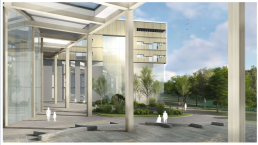
A VISION FOR A NEW HOSPITAL ON A NEW SITE - ESSEX STYLE
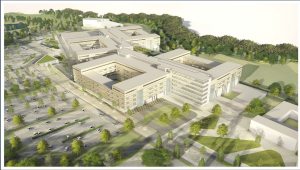
This is what our Health Service can do when it wants the best for patients.
It's the design by the Princess Alexandra Hospital NHS Trust for a new hospital for Harlow in Essex, on a new site away from the centre of town.
A spacious site with plenty of greenery and space. There are car parks, but they will have trees. Buildings are functional but on a human scale, a maximum of seven storeys. There is room for expansion.
Harlow's wise NHS managers rejected town-centre options which would have been short on space.
This is the link to the Harlow Trust's redevelopment plans:
https://newpah.org/
This is what should be possible in West Hertfordshire - but our local Trust stubbornly persist in planning for Vicarage Road tower blocks of up to 16 storeys - a height of 260 feet or so. The £1.3 bn-plus towering infirmary will be surrounded by up to 1500 flats and houses. Access and transport are poor, and will remain poor.
The only real landscaping at the new Watford Hospital will be ... on the flat roofs of the tower blocks.
The cost will put the Trust's fragile finances under pressure for years. That is plain irresponsible.
Why can't West Herts have this quality of hospital? Why must the Trust continue with its plans for a looming hospital on a cramped and difficult site?
What motivates the Trust to refuse even to contemplate a new hospital on an accessible new site?

CARE GAP BETWEEN WATFORD AND DACORUM SET TO GROW AS EMERGENCY DEMAND SOARS
Demand for urgent and emergency care is likely to soar as the population ages, new NHS figures reveal.
Older people need NHS care much more than younger people, with people in their 70s for example having more 'consultant episodes' than any other age group.
But, in Dacorum's case, the NHS is planning to meet the demand for emergency and urgent care by forcing many more people to make the journey to Watford General - and will fail to provide adequately for care in Hemel Hempstead.
Dacorum Council will need to be wary of the NHS plans to sharply increase the Borough's care gap with Watford when considering the next step on a possible Health Campus or Hub for Hemel.
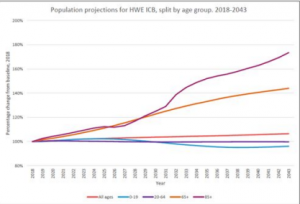
Stunning figures produced by the umbrella NHS body for Herts and West Essex, the ICB, project huge rises in numbers in the whole area's elderly age groups between 2018 and 2043:
- A rise of well over 70% in the number of over-85s, and
- A rise of over 40% in the number of over-65s
This ICB graph sums that up, with the top purple line showing projected numbers of over-85s and the yellow line showing over-65s.
And what is the West Herts Trust going to do to meet the rapid rise in demand? In the years between 2019 and 2036, they plan to provide for:
- A rise of 30% in emergency department activity at Watford General, from just over 107,000 to nearly 140,000 cases a year
- A rise of just over 6% in cases at Hemel urgent treatment centre, from about 40,000 to 42,600 a year, well below what is needed in light of Dacorum's ageing and growing population
The whole point of urgent treatment centres is to divert patients away from accident and emergency departments if they are not in a very serious condition. The Trust seem happy to ignore that sensible policy, in order to ensure that Watford General gets the bulk of development, whatever the demand from the Borough of Dacorum.
There will also be a 20,000 rise in routine appointments at Watford General, against a 7,000 rise in Hemel Hempstead.
THE PLANS UNDERLINE ONCE MORE THE BLATANT BIAS OF THE 'LOCAL' NHS TRUST IN FAVOUR OF WATFORD GENERAL AND AGAINST ADEQUATE DEVELOPMENT FOR DACORUM.
UNLESS THEY ARE STOPPED, THE NHS WILL MAKE DACORUM PEOPLE MORE RELIANT ON THE INACCESSIBLE AND SHAMBOLIC WATFORD GENERAL.

URGENT CARE LONG WAITS SHOW HEMEL HEALTH PLANS ARE INADEQUATE
A local health group today attacked plans for a new health building for Hemel Hempstead to replace the town's existing Hospital as 'inadequate' and showing 'a disappointing lack of ambition'.
New statistics reveal that patients have to wait an average of nearly two-and-a-half hours to be seen at the current Hemel Hospital's urgent treatment centre (UTC). That is above the national target for wait times in such centres, and half an hour longer than the national average. The pressure on the UTC is unrelenting for long periods.
The Dacorum Health Action Group (DHAG) warned against plans which would see demolition of the current Hospital without an adequate replacement. Dacorum Council and the NHS are working on proposals to move services from the Hemel Hospital to a new purpose-built Health Campus on the constrained Market Square site in Marlowes, Hemel's main street. Current plans are for a small urgent treatment centre in the new building, which would apparently just mirror the current Hemel UTC, with little capacity to expand to serve the Borough's growing and ageing population.
Philip Aylett, Chair of DHAG, criticised the plans for failing to take account of changes in demand for health services:
'The current plans for a new Health Campus completely fail to reflect the future needs of Dacorum. It would be very unwise to demolish the current Hospital and replace it with cramped facilities that would soon be overwhelmed by our growing and ageing population. The last thing we want is a glorified GP surgery.'
Dr Aylett said the current planning process was exactly the wrong way around:
'The need for regeneration in Hemel is obvious, and new buildings can certainly help to revive the town. But in rushing to redevelop, the plans put the cart before the horse. The priority should be first to assess future health needs for our growing Borough, then to decide on the best location. Instead, the Council seems prepared to accept the inadequate offer made by the West Herts Hospitals Trust, which has always favoured Watford General and apparently sees Hemel Hospital as something of an embarrassment.
'At the moment the Council is showing a disappointing lack of ambition for our health services. Hemel Hospital has some sound buildings despite years of neglect by the Trust. The UTC is too small and busy and needs to be expanded. We also need many more routine medical appointments at Hemel, so fewer Dacorum people have to make the journey to the building site that is Watford General.
'The Council should stand up to the NHS and demand the services the Borough needs for the future'

WATFORD GENERAL SLIPS IN A AND E TABLE
Watford General's Accident and Emergency rating worsened slightly last month as the key four-hour wait stats deteriorated - and ambulance turnround times lengthened.
But Lister Hospital in Stevenage did even worse on A and E as both Hertfordshire acute hospitals struggled to meet their targets.
At Watford General, only 43.8% of the most urgent (Type One) cases were admitted, transferred or discharged within four hours in November. The official target is to achieve a 95% figure. The average last month in England was 55.4%, so Watford is well below average.
That means that West Herts A and E comes about 109th out of 122 in England on that four-hour measure, a bit lower than last month. But the Lister did even worse, with just 41.1% of the Type One cases within the four hours. And below the Hertfordshire strugglers come a number of desperate cases, with Hillingdon dealing with just 29.6% of Type Ones within four hours.
Ambulance handover times at Watford also got worse in November, with 86.4% of handovers taking over 15 minutes, against 79% in October.
Overall, not a good picture - with three local trusts at or near the bottom of the four-hour table on a regular basis.
Yet Homerton Hospital in Hackney, dealing with some of the poorest areas in the country, manages to deal with 81.7% of Type One cases within four hours. What is wrong with our little group of trusts that they fail to match a hospital which is facing so many challenges? Maybe our managers should visit Homerton - they might learn a thing or two.
DACORUM COUNCIL MUST BE MORE AMBITIOUS WITH HEALTH PLANS
Dacorum Council should press the NHS much harder for improvements to health and hospital services in the Borough, according to Dacorum Health Action Group (DHAG).
Current plans for a Health Campus in the middle of Hemel Hempstead would not give the town or the Borough what they need.
DHAG also pointed to the many advantages of the existing Hemel Hempstead Hospital site, which has some buildings in reasonable condition and offers space for 'clean' beds during a pandemic. The underlying question was - Why Abandon Hemel Hospital?
DHAG Chair Philip Aylett told a 30 November meeting of the Council's Health in Dacorum Committee that plans to replace Hemel Hospital with a Health Campus "appear to fall short of what is required." He continued that the proposed building - on the Market Square on the Marlowes - only looked big enough to accommodate " the limited services planned for Hemel by the West Herts Hospitals Trust."
Dr Aylett said the Trust plan for urgent care at Hemel - projecting a tiny 6% rise in cases over 17 years - "underestimates the likely future demands of Dacorum's ageing and growing population". By contrast, Watford General would see a huge 30% rise in A and E cases and big increases in planned appointments. Dr Aylett said this "continuation of the Trust’s long-standing policy of levelling down means many more miserable, congested journeys to Watford General."
Dr Aylett urged the Council to negotiate with the NHS "to try to secure, for Hemel Hempstead, substantial increases in the range and volume of services beyond those planned by the Trust."
Dr Aylett's full statement to the Health in Dacorum Committee is here:
Health in Dacorum speaking note Final

TELL THE COUNCIL WE NEED BETTER HOSPITAL SERVICES IN HEMEL
There's a crucial chance for everyone who cares about healthcare in Hemel and Dacorum to make the case for BETTER HOSPITAL SERVICES.
With growing controversy over plans to close Hemel Hempstead Hospital and replace it with a Health Campus in Market Square, Dacorum Council are consulting the public over the Borough's Local Plan.
Here's the link to the consultation page:
https://letstalk.dacorum.gov.uk/hub-page/localplan2023
THE FINAL DATE FOR RESPONSES IS 11 DECEMBER.
PLEASE TAKE THE OPPORTUNITY TO PUT THE CASE FOR MORE COMPREHENSIVE HOSPITAL SERVICES IN HEMEL. WE NEED ANSWERS AS SOON AS POSSIBLE TO KEY QUESTIONS SUCH AS:
- WHAT WILL THE HEALTH CAMPUS OFFER TO PATIENTS ?
- WILL THE HEALTH CAMPUS JUST MATCH THE LIMITED SERVICES NOW OFFERED AT HEMEL HOSPITAL, OR
- WILL IT HOUSE BETTER AND MORE COMPREHENSIVE SERVICES AND SOCIAL CARE?
- IS IT WORTH PUTTING UP AN EXPENSIVE NEW BUILDING IF THE SERVICES ARE NO BETTER?
THE COUNCIL ARE PLANNING THOUSANDS MORE FLATS AND HOUSES FOR DACORUM. WE NEED HEALTH SERVICES TO MATCH.